Interview: China's climate envoy warns of energy security risks, urges renewables shift

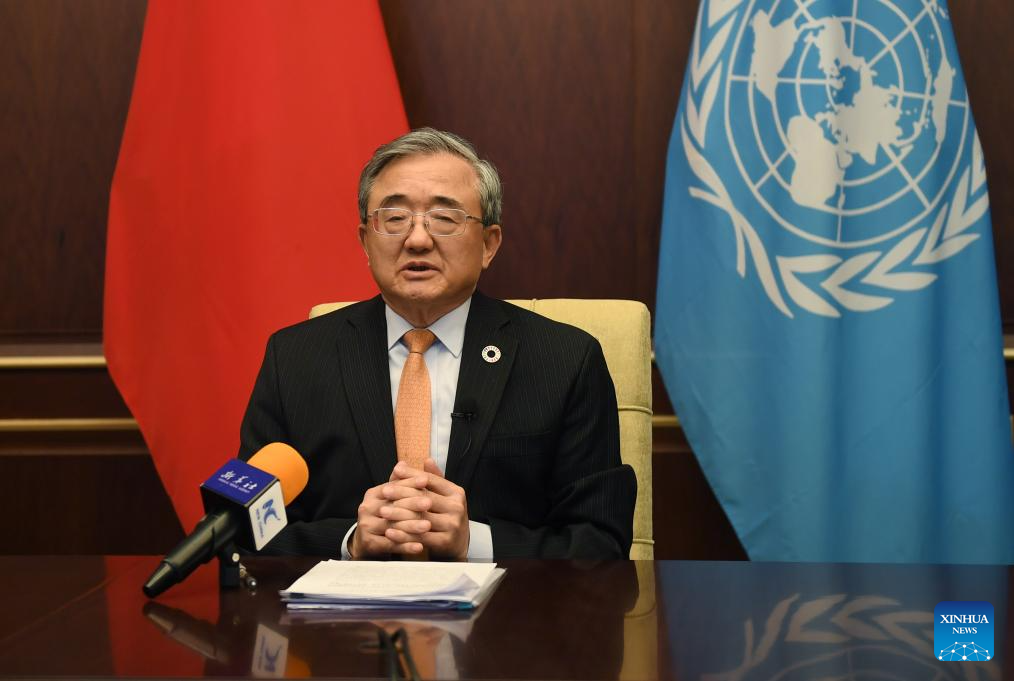
Liu Zhenmin, China's climate envoy for climate change, speaks during an interview with Xinhua in Vienna, Austria, April 10, 2026. (Xinhua/He Canling)
by Xinhua writers Yu Tao, Yao Yulin and Meng Fanyu
VIENNA, April 12 (Xinhua) -- The ongoing global energy crisis has highlighted the risks of heavy dependence on fossil fuel imports, prompting an urgent need for countries to rethink their energy security strategies and accelerate the transition to renewable energy, Liu Zhenmin, China's climate envoy for climate change, has said recently.
In an interview with Xinhua on Friday during the International Vienna Energy and Climate Forum, Liu emphasized that China's experience shows that developing renewable energy is an effective way to enhance energy security and resilience.
The forum, themed "Powering Prosperity, Security and Stability," was held in Vienna on April 9-10. It was jointly organized by the United Nations Industrial Development Organization, Austria's Federal Ministry for European and International Affairs, the Austrian Development Agency, and the International Institute for Applied Systems Analysis.
Liu noted that while the current energy crisis may slow economic growth for some countries in the short term, it also serves as a warning against over-reliance on a single source of energy imports. He stressed that diversifying energy systems and accelerating the shift to renewables are essential for long-term stability.
According to the Paris Agreement, countries must work to limit global temperature rise to well below 2 degrees Celsius, ideally 1.5 degrees, above pre-industrial levels. To achieve this goal, countries need to accelerate their energy transition to cut emissions. This process is not just a shift in energy mix but a profound economic transformation, said Liu.
He pointed out that developing countries face greater challenges in this transition, as many developed countries have already completed their industrialization. To support global carbon neutrality by mid-century, Liu suggested that developed countries should aim to reach carbon neutrality by around 2040, creating more space for developing nations.
"The next five years will be critical," Liu said, urging countries to accelerate their efforts to curb global warming while ensuring market stability.
As a developing country, China is willing to deepen cooperation with international institutions and developed nations through bilateral, trilateral, and multilateral frameworks, and to help countries in the Global South to advance their energy transitions and achieve sustainable development goals, Liu said. ■


